 The Hosting Lexicon
A short history of web hosting
The short version
- The web began on one computer at CERN. That computer was the first web server.
- In the mid-1990s, companies began to rent out space on their servers. Web hosting became a business.
- Later, one real server was split into many virtual ones. Then came the cloud.
- Today, many sites are plain files again, as the first one was.
1989 to 1990: one computer, one website
Tim Berners-Lee invented the World Wide Web in 1989. He was working at CERN, a physics laboratory.[1]
The first website was about the web project itself. It lived on Berners-Lee's own NeXT computer.[1]
That machine was the first web server. A web server is a computer that stores web pages and sends them out when asked. The first one was called nxoc01.cern.ch, and later info.cern.ch.[2]
A label on its case read: "This machine is a server. DO NOT POWER IT DOWN!!"[3] The warning made sense. If someone switched it off, the whole website vanished.
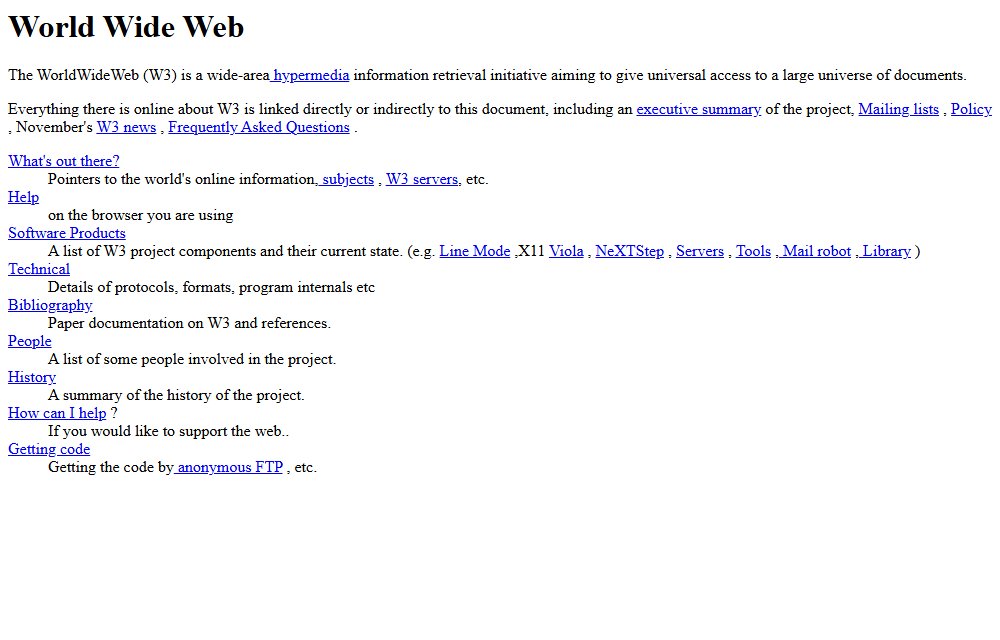
CERN began restoring that first website in 2013.[1] Anyone can still visit it at the old address.

1991 to 1993: servers spread
The program that ran on the first server was called CERN httpd. It was the first web server software.[4]
In August 1991, the web's files were put online for anyone to download.[2] By December 1991, the first web server outside Europe was running. It was at SLAC, a laboratory in the United States.[2]
Growth was fast. In January 1993 there were around 50 known web servers. By October 1993 there were over 200.[2]
On 30 April 1993, CERN put the web software in the public domain.[1] Anyone could now run a web server without paying a fee.
1994 to 1996: hosting becomes a business
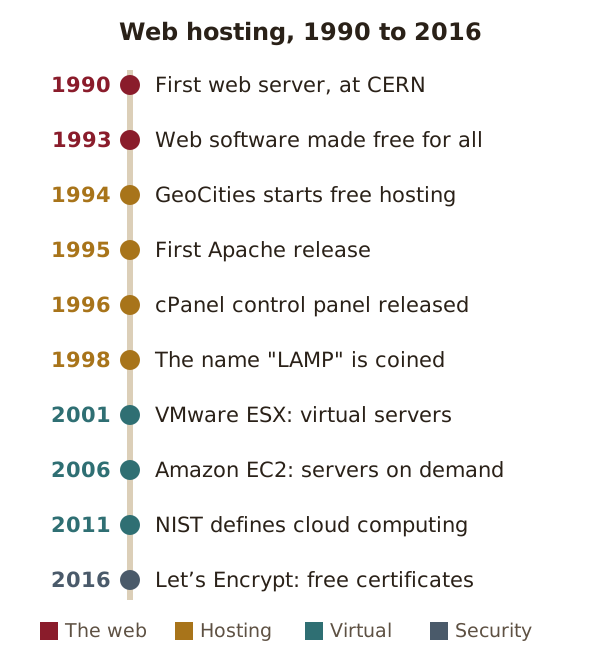
At first, a website meant owning a server. Not every company had the money or skills for that. So web hosts began to offer space on their own servers instead.[5]
Free hosting came early. GeoCities started in November 1994.[6] By 1995, GeoCities and others were offering free hosting.[5]
Server software moved on too. A group of webmasters made the first public release of Apache in April 1995.[7] Within a year, it was the most used server on the internet.[7]
Tools for building pages on the server arrived. PHP was created in 1994. At first it only counted visits to one man's online CV.[8] The control panel cPanel, used to run hosting accounts, was first released in March 1996.[9]
Late 1990s: stacks and delivery networks
Many hosts used the same free software together. In December 1998, this set was given a name: LAMP.[10] It stands for Linux, Apache, MySQL and PHP. See LAMP stack.
Busy sites needed help with traffic too. Content delivery networks arose in the late 1990s.[11] They keep copies of a site on servers closer to each visitor.[11] See Content delivery network.
2000s: virtual servers and the cloud
Virtualisation lets one real computer act like several separate ones. It became common on everyday servers after VMware ESX Server came out in 2001.[12] Hosts used it to sell the virtual private server.
In 2006, Amazon released its Elastic Compute Cloud, or EC2.[13] People could now rent computing power on demand.
In September 2011, the US standards body NIST published a definition of cloud computing.[14] It describes a shared pool of computing resources that people reach over a network.[14] See Cloud hosting.
2010s onward: free certificates and static sites
A certificate lets a site use a secure, encrypted connection. Let's Encrypt gives them out for free.[15] It launched on 12 April 2016.[16] See Certificate authority.
Simple hosting also came back. Many services now build a site straight from its source files and serve it as plain files.[5] See Static site.
In a way, the story has come full circle. Like the very first website, many modern sites are simple files on a server.
Sources
- The birth of the Web, CERN (accessed 2026-10-18)
- A Little History of the World Wide Web, W3C (accessed 2026-10-18)
- Web server, Wikipedia (accessed 2026-10-18)
- CERN httpd, Wikipedia (accessed 2026-10-18)
- Web hosting service, Wikipedia (accessed 2026-10-18)
- GeoCities, Wikipedia (accessed 2026-10-18)
- About the Apache HTTP Server Project, The Apache Software Foundation (accessed 2026-10-18)
- History of PHP, The PHP Group (accessed 2026-10-18)
- cPanel, Wikipedia (accessed 2026-10-18)
- LAMP (software bundle), Wikipedia (accessed 2026-10-18)
- Content delivery network, Wikipedia (accessed 2026-10-18)
- Virtual private server, Wikipedia (accessed 2026-10-18)
- Cloud computing, Wikipedia (accessed 2026-10-18)
- SP 800-145: The NIST Definition of Cloud Computing, NIST (accessed 2026-10-18)
- About Let's Encrypt, Let's Encrypt (ISRG) (accessed 2026-10-18)
- Let's Encrypt, Wikipedia (accessed 2026-10-18)